Real Cameras are Radiometric
Lifting geometric camera models to radiometric ones
Ties Harder, Felix Seegräber, David Nakath Hendrik Sauer, Kevin Köser, James Pritts Marine Data Science Kiel University arXiv 2026
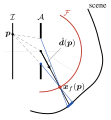
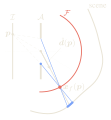
Any central camera, lifted
The radiometric camera keeps the projection of a geometric model — Brown–Conrady, OpenCV, Kannala–Brandt, Double Sphere or a generic spline — and adds a finite aperture, a free-form focus surface and a generic vignetting function.
Calibrated by inverse rendering
The camera is calibrated on the RAW photosites of the same images of standard targets that a geometric calibration uses, without a feature detector, by a maximum-likelihood fit of rendered to measured radiant flux.
More accurate, and physically meaningful
The calibrated cameras have lower reprojection errors on a held-out high-precision target, their vignetting reproduces a measured flat field, and their focus surfaces recover sharp texture from defocused images.
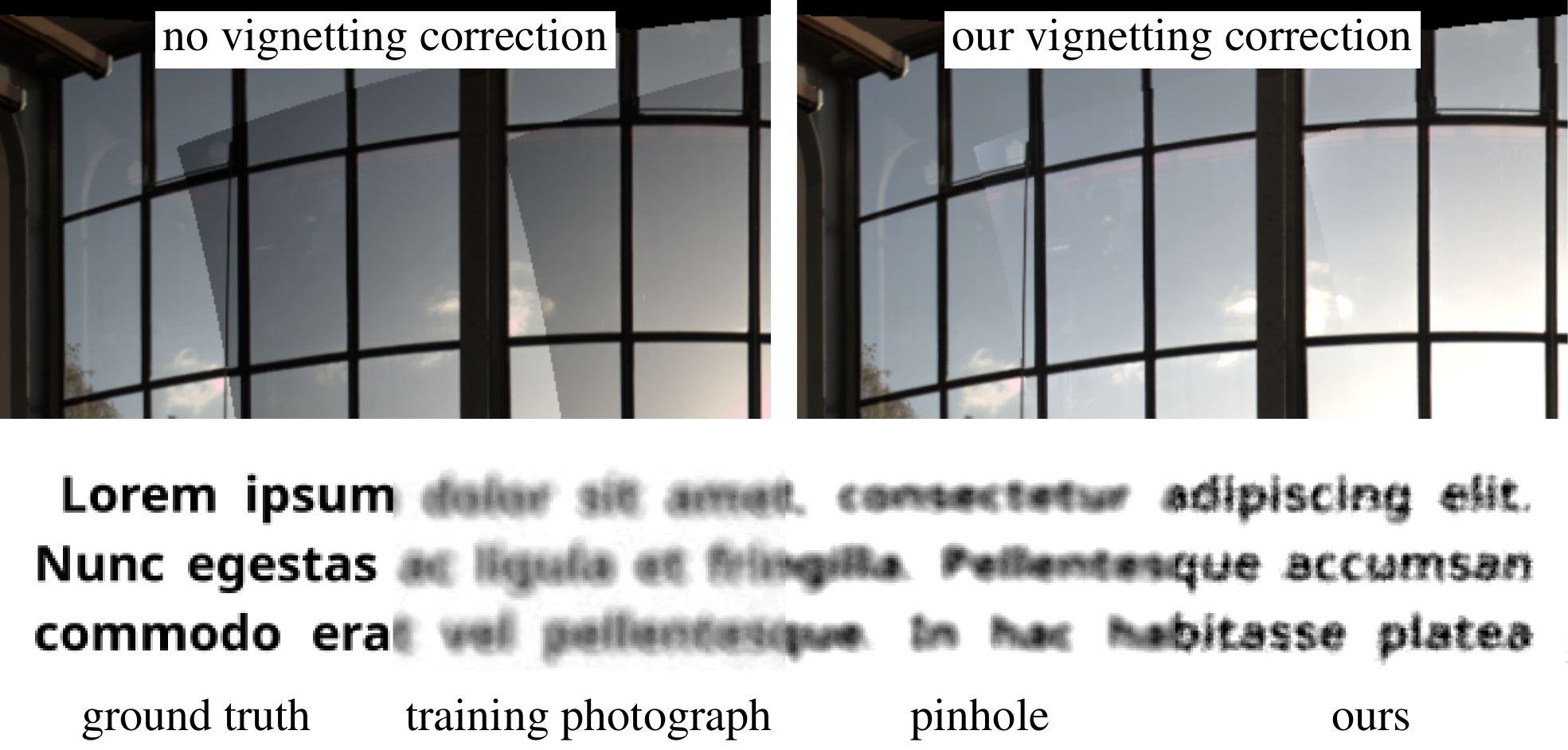
A camera model with an aperture, a focus surface and a vignetting function around any central geometric model, calibrated from the light the sensor measures.
Abstract
We propose the radiometric camera, a model that lifts any central geometric camera model to a radiometric one. The lifted model keeps the projection of the geometric model and adds a finite aperture, a free-form focus surface and a generic vignetting function. We calibrate it by inverse rendering directly on the relative irradiance of the sensor, from the same images of standard calibration targets used in geometric calibration. Geometric calibration absorbs the bias of its feature detections. The proposed radiometric calibration uses no features, and our radiometric cameras have lower reprojection errors on held-out test sets. The focus surface extends defocus modeling from the thin lens to any central camera, and we use it in a first multi-view radiometric reconstruction, which recovers the in-focus reflectance of a texture from defocused images. The vignetting is estimated jointly and accurately reproduces a flat field measured through a diffuser. Because every standard camera model lifts to a radiometric one, the radiometric camera naturally and directly extends generative scene models beyond multi-view geometry to multi-view radiometric ones, where phenomena such as lighting and attenuation can be accurately estimated.
Install
RadiometricCamera requires Julia 1.13 or later. It is registered in CauRegistry, with the Visual Radiometry Toolkit packages it builds on; add that registry once, beside General, then the packages:
pkg> registry add General https://github.com/prittjam/CauRegistry.jl
pkg> add RadiometricCamera VisualGeometryToolkitCore VisualRadiometryToolkitCore
Getting started
A radiometric camera is one object: a geometric camera (any central model of the VisualGeometryToolkit), a focus surface, an aperture radius and a vignetting function. A photograph is the camera at a pose. The example below builds a 320 × 240 px fisheye camera 1.5 m in front of a printed checkerboard and renders the radiant flux of every pixel through the camera's aperture and focus surface. The Getting Started guide continues from here: it renders two photographs and recovers the lighting, the vignetting and the material from them.
using RadiometricCamera, VisualGeometryToolkitCore, VisualRadiometryToolkitCore
using RadiometricCamera: RenderSettings, compute_mask, render_view, sphere_radius, Φ_pixel, 𝔟
using VisualRadiometryToolkitCore: Material

# A printed 2 m × 2 m checkerboard of 8 × 8 squares, and a 320 × 240 px fisheye
# camera (Core's double-sphere lens) 1.5 m in front of it, looking at it.
texture = [Float64(isodd(fld(i - 1, 32) + fld(j - 1, 32))) for i in 1:256, j in 1:256, c in 1:3]
board = TexturedTarget([-1.0, -1.0, 0.0], [2.0, 0.0, 0.0], [0.0, 2.0, 0.0], texture; facing = [0.0, 0.0, 1.5])
W, H = 320, 240                               # the image, in pixels
K = CameraCalibrationMat(412.0, 0.0, 0.0, 0.0, 412.0, 0.0, W / 2, H / 2, 1.0)   # focal length 412 px, principal point at the centre
geometric = BoundedCamera(CameraModel(K; lens = Lens(DoubleSphere(0.25, 0.4))), Size2(W, H))

# The radiometric camera, one object, composed from the geometric camera: focused at 1.5 m, aperture radius 4 cm, and no
# vignetting (VisualRadiometryToolkitCore's NoVignetting, the default: V ≡ 1, no parameters).
camera = RadiometricCameraModel(geometric; focus = 1.5, aperture_radius = 0.04)
# The photograph's pose, camera → world, metres: lookat_pose(camera centre, the point it looks at, the world's up direction, which fixes the roll)
pose = lookat_pose(Vec3(0.05, -0.05, 1.5), Vec3(0.0, 0.0, 0.0), Vec3(0.0, 1.0, 0.0))
light = EnvironmentLight(SphericalHarmonicMap(1.0, 2), 𝔟(board), sphere_radius(𝔟(board), [pose.t]))   # VisualRadiometryToolkitCore's light, L ≡ 1
settings = RenderSettings(; n_𝐩 = 2, n_ρ = 3, n_φ = 8, N = 4)
mask = compute_mask(camera, pose, board, settings; δ = 0.02, backend = RadiometricCamera.rc_backend("cpu"))   # the device: rc_backend of a compute tag (public, not exported)
img = render_view(1, camera, pose, Material(), light, board, settings, mask)   # photograph 1 (its index keys its Monte Carlo samples)
count(mask)                     # 76800 = W × H: the board covers every pixel
Φ = Φ_pixel(160, 120, 1, camera, pose, Material(), light, board, settings)   # the pixel 𝐮 = (u, v) = (160, 120)
Φ ≈ img[120, 160, :]            # true: the render is Φ_c(𝐮) of each pixel (img is H × W × 3: row v, column u)
Method
A geometric camera model maps a sensor point to one ray through its center of projection. The radiometric camera keeps that mapping and replaces the pinhole by an aperture:
- Aperture and focus surface. The rays from a sensor point through all points of the aperture meet in one point of focus. These points form a free-form focus surface, which is learned: close to a plane for a wide-angle lens, close to a sphere for a fisheye. With a pinhole aperture, the model is the geometric model it started from.
- Vignetting. A generic radial function about the principal point replaces the cos⁴ falloff of the thin lens, which real lenses do not follow.
- Calibration. The images of a calibration target are rendered and fitted to the RAW photosites under the noise model of the sensor. The formulation has no boundary terms, so every parameter of the camera, including the aperture radius and the focus surface, is differentiable, and its gauge freedoms are removed by the parameterization.
Results
- Geometric accuracy. On a held-out high-precision target, the radiometric refinement lowers the median reprojection error significantly for 82 % of 28 combinations of camera model, lens and calibration target, and the 95th percentile for all of them.
- Vignetting. The learned vignetting follows a measured flat field for three lenses, with an RMS deviation of 0.009 to 0.042 of the value at the principal point, against 0.059 to 0.244 for the cos⁴ falloff.
- Defocus. Modeling the aperture and the focus surface lowers the median reprojection error by 25 % and 16 % against the same refinement with a pinhole aperture.
- A first multi-view radiometric reconstruction. From defocused images of a printed page, the radiometric camera recovers sharp text where a pinhole camera returns the blur of the images.
Paper
The paper and its supplementary material are on arXiv: arXiv:2611.25265 (PDF). The manuscript's source is in the repository.
Code and documentation
The code, the experiments that reproduce the paper and the manuscript are in one repository:
RealCamerasAreRadiometric/realcamerasareradiometric.github.io.
The Julia package RadiometricCamera.jl is its subdirectory RadiometricCamera/;
its documentation covers the installation, a tutorial, the calibration and the API.
The calibration is built on the VisualGeometryToolkit.
Data
Coming soon: the RAW images and the configurations of every experiment.
Related projects
- BlobBoards: robust markers for accurate pose.
- VisualGeometryToolkit: the geometry stack this work is built on.
Citation
The radiometric camera is described in Real Cameras are Radiometric, arXiv 2026 (PDF, with supplementary material). If you use this project for your research, please cite:
@article{harder2026radiometric,
  author        = {Harder, Ties and Seegr{\"a}ber, Felix and Nakath, David and
                   Sauer, Hendrik and K{\"o}ser, Kevin and Pritts, James},
  title         = {Real Cameras are Radiometric},
  journal       = {arXiv preprint arXiv:2611.25265},
  year          = {2026},
  eprint        = {2611.25265},
  archivePrefix = {arXiv},
  primaryClass  = {cs.CV},
}
Acknowledgments
James Pritts is funded by Kiel Training for Excellence, an EU Horizon Europe programme under the Marie Skłodowska-Curie Actions (MSCA), grant agreement No. 101081480, and by KMS Kiel Marine Science – Centre for Interdisciplinary Marine Science at Kiel University.